I’m often a bit of a purist, but as I age, I’m realising more and more the history of the web, much like most other histories is a pretty messy pit of layers laid on top of layers. After reading this revolutionary email from the birth of the img tag, I’m reminded we’re just working on the next layer so it’s probably going to be messy ;).
I have been reading this evening over people’s thoughts about how we tackle responsible responsive images and there seems to be no perfect method. In fact many of the methods currently being seen have major gotchas. It just feels like we are far from getting a stable way of providing responsive images using the img tag.
I did a lunchtime session on some Git basics last week. It is clearly a different mindset which takes a bit of time to adapt to. But it’s worth the effort, the popularity of Github, now sitting at over a million users should be a good indication that there’s a few treasures awaiting.
Here are a couple of books which will hopefully be useful to grow your git knowledge.
Pro Git Book
The Pro Git book can be read online or downloaded for free on various eReader formats. You can also get the paper copy from Amazon.
I have been getting frustrated with the readability of the article body text within Google Reader. It’s just a bit too small and I find it much easier to read serif fonts for large sections of text. I also adjusted the line-height to improve legibility.
So I have created a user stylesheet with http://userstyles.org which changes the body text to something a bit better.
I’ve been taking a look over all that has happened this year as it seems to have disappeared in a bit of a haze and there have been a few great things that I would like to remember 2011 for.
Projects and Work
At the beginning of the year I was running the front-end work on my own at Aqueduct. It was great to get Steve on board on the 17th of Jan (one of the best decisions of the year).
I’ve just finished reading Html5 for web designers by Jeremy Keith and would really recommend it. It’s not too big, I managed to finish it in 4 train journeys and I’m a slug when it comes to reading speed.
If you subscribe to Jeremy’s journal you’ll be familiar with his very laid back and personal writing style, injecting a welcome amount of wit to break up the reading.
I wasn’t quite aware of the relationship between the W3C and the WHATWG. It’s very interesting to see how the HTML5 spec is being put together. And now I actually understand what they are talking about when they refer to “paving the cowpaths”. It essentially is the mindset that if something already exists and it’s use is widespread then make it part of the spec (event if there is a better solution) and outline exactly how we should be using it consistently. The more I think over this the more I like it, “If it ain’t broke, don’t fix it” as Jeremy puts it.
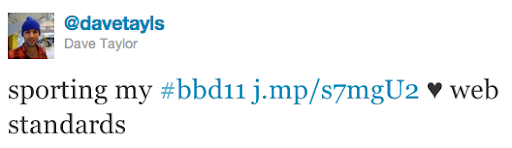
174 people have put their pic up on the Flickr group and changed their social avatar all to show we ♥ web standards and we’re actively adhering to best practices for standardised, accessible, universal web design.
I’m all for making the web available for all. There is still far to go, especially as the landscape is ever changing. I was reading the other day how fast the mobile web is expanding due to the take-up of devices being used in asia and africa. Often people will have a web-enabled mobile device before a computer. I’ve seen some criticism of the mobile first approach, how it isn’t cost effective for companies. I’m in the middle of a couple of projects at the moment where for a small increase in the budget of the project they are making their site so much quicker and more accessible for the mobile web. I have to admit it is a steep learning curve, especially when it comes to interactive features being turned on and off at different sizes but this definitely feels like the way forward, and we’ll gradually get the tools and build the code we need to make the process smoother.
It’s always nice to start another responsive project, each a little more daring than the last. I’m still in the infant stages with these projects as I find that I’m lacking some good tools to make the process easier. I’ve created a a simple responsive device browser which simply gives an at a glance impression of how a responsive site will look at the various screen widths.
I’m finding one of the biggest challenges is catering for the user to be able to resize the browser window once it has been loaded. One may think that this isn’t likely to happen very often. Especially not to the extent where it starts off less than 480 and increases to above 768. This is exactly what happened on my last project where someone’s browser settings opened certain links in a new window which happened to be tiny. They then realised they wanted it larger and maximised the window to find that most of the functionality hadn’t been initialised because the JavaScript turned on only the small touch device functionality on load.
Bandwagons come and go, when looking back there are so many which fall in to the category “forget/can’t believe I jumped on” but with the rise of require js and other module loaders using the commonjsAsynchronous Module Definition I think this is one bandwagon everyone should be considering seriously.
In my position at the digital agency I work for, I’ve been considering the ever widening landscape of client expectations from new forms of UX on devices, locations and interactions within social circles. More and more is being requested and without modularising these features in to well tested silos the time needed to satisfy clients hunger could potentially sky rocket.
 Dave Taylor - Software Engineer